
AI voice agents
A phone agent that picks up on the first ring, understands what's being asked in natural language, books the appointment and puts the call through to you when a human is needed.
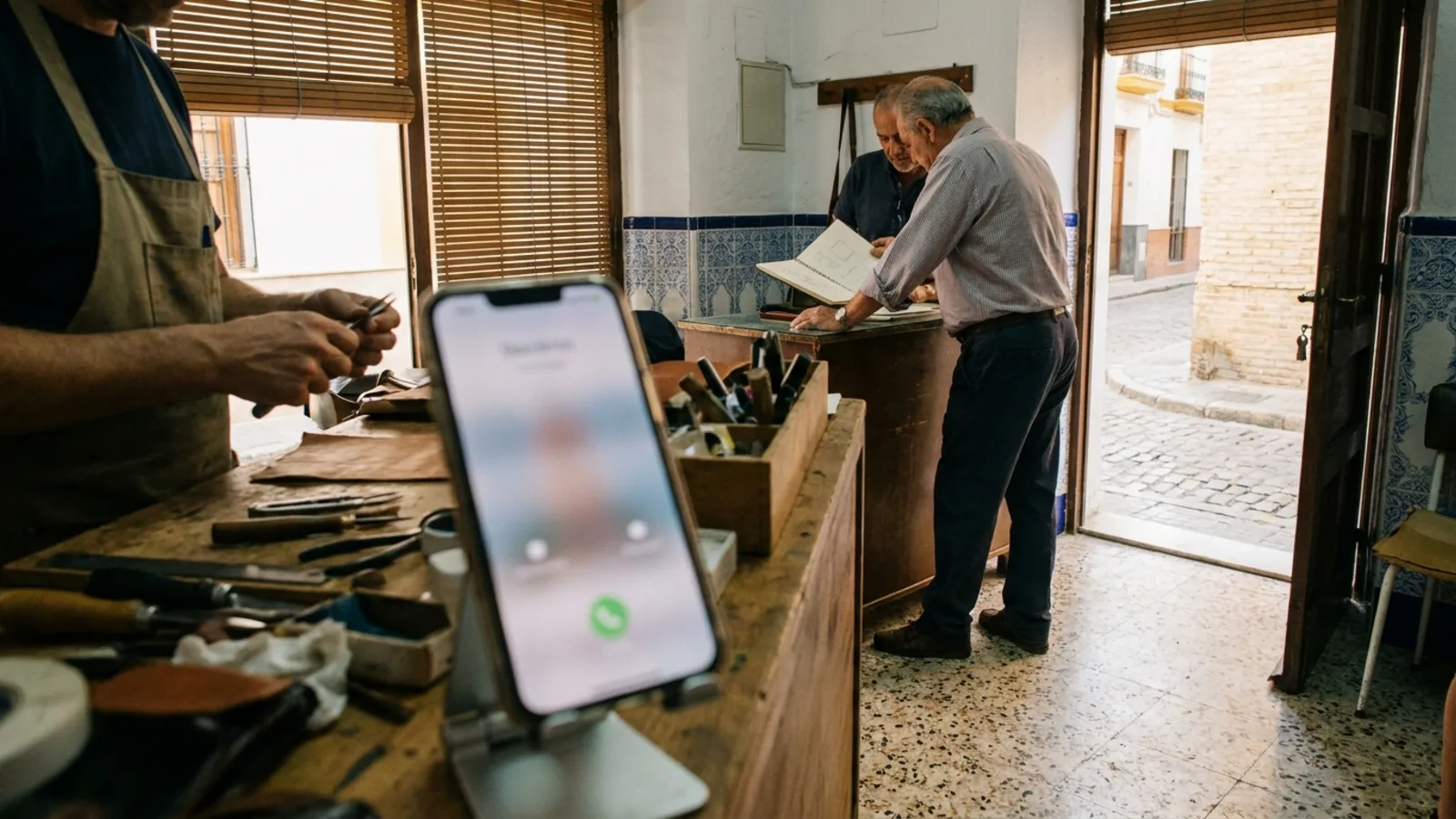
In some businesses the customer doesn't write: they ring. The garage when the van won't start, the clinic to move an appointment, the advisory firm whose clients have no intention of opening a chat. And the call you don't pick up leaves no trace anywhere: it isn't in the diary, it isn't in the inbox, it doesn't sit waiting in a conversation. That's why nobody knows how much work is being hung up on. A voice agent answers that call and writes down what the person on the other end wanted.
The call you don't pick up doesn't show up anywhere
An unanswered WhatsApp message stays there, in bold, nagging until someone opens it. An email, the same. A missed call on the business phone, no: if the number isn't saved or nobody checks the log, it's gone and nothing is left. Not who it was, nor what they wanted, nor whether it was the big quote of the month or someone asking your opening hours. That's the odd gap in this channel: you lose customers without knowing you've lost them, so it never comes up in any meeting. The first thing a voice agent does, before booking anything, is turn that into something you can read.
If there's nobody to hand the phone to, nobody answers it
In Spain, 54.4% of companies have no employees at all: just the owner, according to the central business directory of Spain's National Statistics Institute (INE). There's no reception to divert the call to. The phone is carried by the same person who is under a car, with a patient in front of them or driving. Answering means dropping what you're doing; not answering means it's lost. Hiring someone just for that rarely adds up, and voicemail only works if the caller bothers to leave a message. A voice agent fills that gap, and doesn't tire when several calls come in one after another.
Source: INE (Spanish National Statistics Institute), Central Business Directory (DIRCE) as at 1 January 2025
What it leaves in writing when it hangs up
Two versions of the same Monday. Version A: three missed calls at half past nine, two of them with no number. Version B: three records. A customer whose van has broken down and wants to bring it in tomorrow, with a phone number and a slot at ten. Someone moving their appointment from Thursday to Friday, already moved in the diary. And someone asking something the agent can't answer, with the reason written down and flagged for you to call back. The agent collects whatever you tell it to: the reason, the registration number, the file number. And it leaves it where you'll look: your diary, your CRM or the WhatsApp of whoever is on call.
It isn't the usual answering machine
What people picture when you say phone agent is press one for appointments, press two for billing. This isn't that: there's no options tree; callers speak the way they speak, say what they need in their own way and the agent understands. You can interrupt it mid-sentence and it replies without the usual awkward silence. That said, it isn't magic. With lots of background noise, two people talking at once or poor signal, it gets things wrong. What matters more is what it does then: it doesn't leave the caller going round in a loop, it puts them through to a person or takes a message.
It has to say it's a machine, and it does
The EU AI Act requires an automated system to identify itself as such to the person it's talking to. No pretending to be Ana from reception. In practice it's dealt with in the first sentence, and it isn't the commercial problem you imagine: what annoys callers isn't talking to a machine, it's being unable to get things sorted and unable to get out. So the agent says what it is and always leaves open the option of speaking to a person. Add the obvious: if you record calls, you have to tell people they're being recorded.
Source: European Commission, regulatory framework for artificial intelligence
You test it by ringing it, and sometimes we'll tell you no
You can judge this before signing up. We set up the agent with your services, your hours and the questions you really get asked, and you ring it from your mobile. If hearing it doesn't convince you, we stop there. And there are cases where it isn't worth it: if you get few calls and answer them all, if every conversation is a different negotiation that needs judgement, or if you have no digital diary to write the appointment in. Nor do we build agents to cold-call people who haven't asked to be called: it isn't legal in Spain and it doesn't do you any good. Tell us about your case and we'll tell you whether we can do it, how we'd approach it and what it would cost. If it isn't for us, we'll tell you that too.
Frequently asked questions
- Can callers tell it isn't a person?
- They can, and they have to: EU rules require it to identify itself as an automated system at the start of the call. What you won't hear is the robotic voice of years ago or a press-a-key menu. It speaks at a normal pace, can be interrupted and also understands people who don't explain themselves very well.
- What if the customer wants to speak to a person?
- It puts them through. It's the first rule we configure: as soon as someone asks, or as soon as the agent sees the matter isn't one for it, the call goes to whoever you choose. If nobody is available at that moment, it takes the reason and the phone number and flags it for a call back, with what was said written down.
- Can it answer a clinic's phone?
- Yes, on one condition: the reason for a medical appointment is special category data and has to be treated as such, as the Spanish Data Protection Agency's guidance on artificial intelligence points out. That shapes what's asked, what's stored and who can see it. Sometimes the right answer is for the agent to book the appointment and not ask the reason.
- Does it replace the WhatsApp chatbot?
- No, they're different channels for different customers. Some people will never write and some will never ring. The voice agent answers the phone; the text assistant answers WhatsApp or the website. Both can run on the same diary and the same CRM, so you don't end up with two places that don't talk to each other.
How we work
01
Understand
We sit down with you and look at how you really work. We come away knowing what makes sense to build and, above all, what doesn't.
02
Build
We build it on the tools you already use and show it to you working, not in a slide deck.
03
Stay with you
We measure, we adjust and you can always reach us. Software isn't something you install and forget.
Other services
Chatbots and conversational AI
Assistants that talk to your customers on WhatsApp and actually sort things out.
See detailsWeb development
Custom websites and platforms, with AI built in from day one.
See detailsCustom applications
Software that doesn't exist on the market because your process is yours.
See details