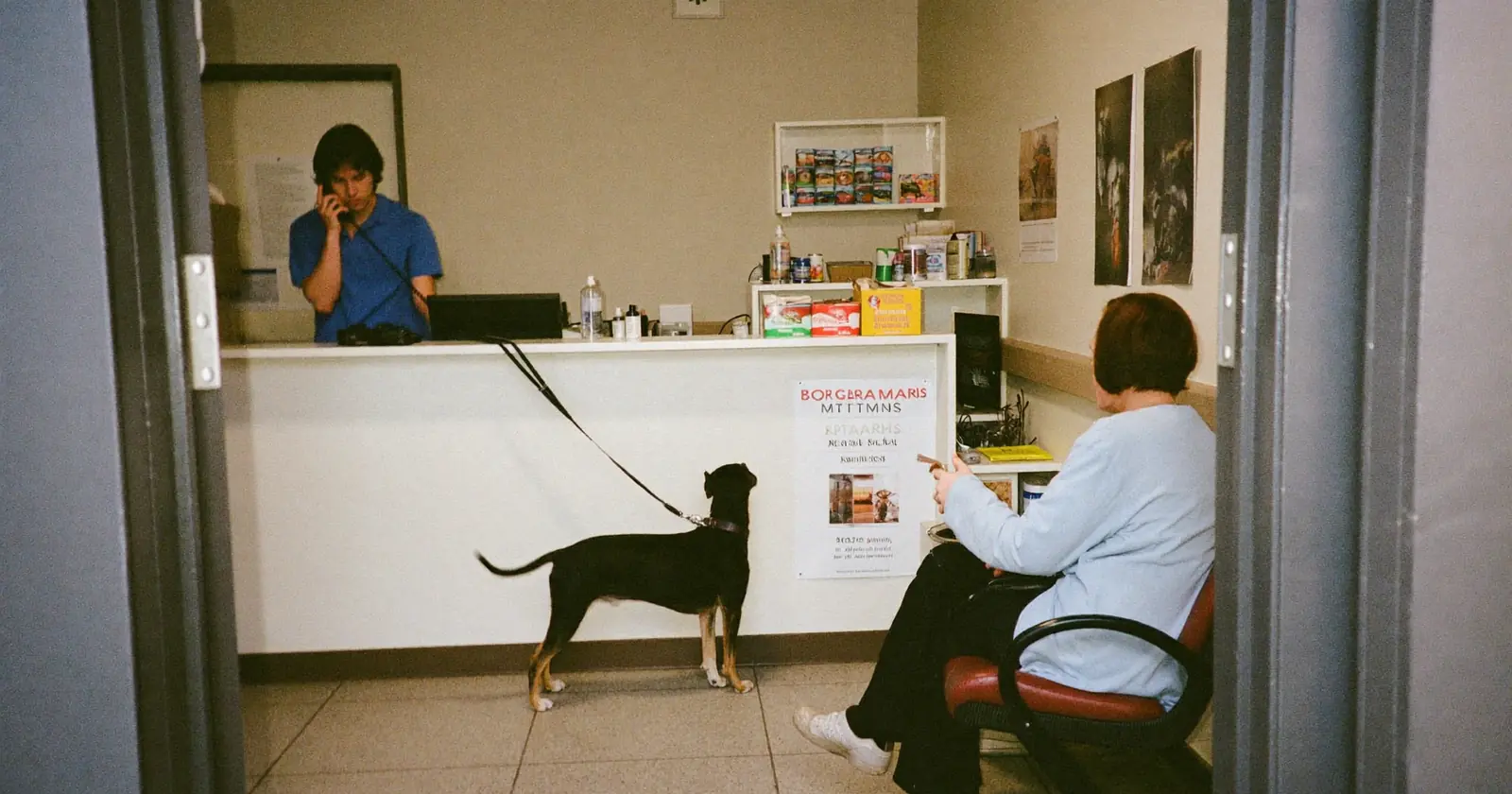
It is quarter past twelve. The vet has a sedated cat on the operating table and both hands busy. The phone rings at reception. In many clinics nobody answers because there is nobody to answer: according to the INE Central Business Directory (Spain's National Statistics Institute), on 1 January 2025, 54.4% of Spanish businesses had no employees at all. In a clinic like that, the person who operates and the person who answers the phone are the same.
The caller wanted an appointment to vaccinate their puppy. They will call again, or they won't. And that night, at eleven, another owner will send the clinic's WhatsApp a photo of her dog's paw with an “is this urgent or can it wait until tomorrow?”. The message will go unread until the next day.
A WhatsApp chatbot for veterinary clinics takes care of the first part of the problem: automating bookings, reminders and notices. The second part (deciding whether that dog's paw can wait) it does not and must not deal with, and in this article we are going to be very clear about that boundary. About the channel there is little to argue: according to Eurostat, 94.7% of the Spanish population used instant messaging in 2025, against an EU average of 82.3%. The pet owner is already on WhatsApp. The question is who answers them.
What does a WhatsApp chatbot do in a veterinary clinic?
If you want an overview of how these systems work, you have it on our chatbots page. What is specific to the veterinary sector is this:
Appointments without going through the phone
The owner writes “I want an appointment to vaccinate my dog” and the chatbot shows the available slots, collects the animal's details (name, species, age, whether it is a first visit) and confirms. The appointment goes into the diary without anyone at the clinic getting involved, even in that after-dinner window when people remember things about the dog. If the reason for the visit is clinical and not routine, the chatbot notes it exactly as the owner describes it so the vet can read it before the visit, without giving an opinion on it.
Vaccine and worming reminders
This is where the change is most noticeable. In most small clinics, the reminder for the rabies vaccine or the quarterly worming depends on someone finding a spare moment to go through records and write messages one by one. That moment doesn't exist, so the reminder isn't sent and the animal comes back when the owner remembers.
The chatbot does it by itself, with one condition that matters: the intervals are set by the clinic. The system doesn't decide vaccination schedules or antiparasitic routines; it applies the ones your veterinary team has defined for each species and each treatment, and sends a notice when it is due: “Luna is due her rabies booster this month. Would you like to book an appointment?”. It is the same reminder mechanism that already works in dental clinics, with the difference that here the patient doesn't read messages: the one who has to remember is the owner.
Pick-up alerts
Surgery in the morning, a whole afternoon of calls asking whether the animal can be collected yet. With the chatbot the flow is reversed: when the patient is awake, stable and ready, someone at the clinic marks it in the system and the owner gets the alert on their phone, with whatever pick-up instructions the clinic wants to attach. The same goes for dog grooming: “Rocco is ready, you can come and get him”.
The usual questions
Opening hours, address, whether you see exotic animals, whether fasting is needed before sedation, what to bring to the first visit, what recovery after neutering is like in terms of the general care instructions the clinic already has written. The chatbot answers all of that at once with the texts your team has approved, and leaves the phone free for what does need a person.
Can the chatbot tell the owner whether it is urgent?
No. And this part is not negotiable, even for a client who asks us for it.
The photo of the paw at eleven at night is the perfect example. The chatbot doesn't interpret photos, doesn't assess symptoms, doesn't reassure and doesn't alarm. Any message with clinical content (“he's been vomiting since yesterday”, “can I give him ibuprofen?”, a picture of a wound) is passed to a person. What the system does do is the administrative side around it: it replies instantly with the emergency hours and emergency phone number the clinic indicates, makes clear that it cannot assess the case, and saves the conversation so the vet can read it with all the context as soon as they are available.
There is a reason of principle and a legal one. The reason of principle: a mistake by a machine playing at triage is paid for with an animal's health, and no time saving makes up for that. The legal one: the EU AI Act (Reglamento europeo de inteligencia artificial), in force since August 2024, imposes transparency obligations on chatbots from August 2026: whoever is writing has to know they are talking to an automatic system, and an automatic system that appears to have clinical judgement is exactly the opposite. At Xora, veterinary chatbots inform, book and remind. Diagnosing is for the vet.
What about no-shows at the dog groomer's?
Dog grooming carries the same problem as human hairdressers, which we already covered in the article on hairdressers and beauty salons: long services, a tight diary and people who book and don't turn up. A full bath and trim blocks a long hour of table time; if the owner doesn't come and doesn't tell you, that slot is dead.
The chatbot doesn't eliminate absences. It reduces them in the boring way that works: a reminder 24 hours before with the option to confirm, change or cancel in one tap. A cancellation frees the slot in the diary straight away, while there is still time to offer it to another client, instead of finding out when the dog doesn't show up.
Who answers the phone while you are in a consultation?
There are owners, especially older ones, who are going to keep calling by phone, and rightly so. For that front there are voice agents: the same rule (appointments, opening hours and messages yes; medicine no) applied to calls. Combining the two channels means the clinic always answers, even if whoever runs it has an animal on the table, and that the conversations that really need a vet reach them in order instead of being lost among ringtones. If you want to see how the same thing applies to other trades in the Campo de Gibraltar, you have the AI use cases by sector for the area.
Frequently asked questions
Does the chatbot decide when each vaccine or worming is due?
No. The schedules and intervals are defined by the clinic's veterinary team, by species and by treatment. The chatbot only runs the reminders with those routines and updates them when the clinic changes them.
What happens if an owner describes symptoms or sends a photo?
The chatbot does not assess it. It replies that the vet has to see that query, provides the emergency hours and contact the clinic has set up and passes the conversation to a person with everything the owner has already said.
Does it work for a clinic with a single vet?
That is where it shows most. With no reception staff, every call missed during a consultation or surgery is an appointment that may not come back. The chatbot covers that front while you work with your hands full.
Does it integrate with the clinic's management software?
We work with the usual management programs in the veterinary sector and, if the clinic keeps its diary in Google Calendar or a simple system, with those too. We assess the specifics of your case in the first meeting.
If you have a veterinary clinic and want to get the phone off your back without giving up clinical judgement, tell us your case and we will tell you whether we can do it, how we would approach it and what it would cost. If it isn't for us, we will tell you that too.

Xora IntelligenceAI consultancy and custom software in Los Barrios (Cádiz). We write about what we build for businesses in the province. If you have a question about your case, write to us.