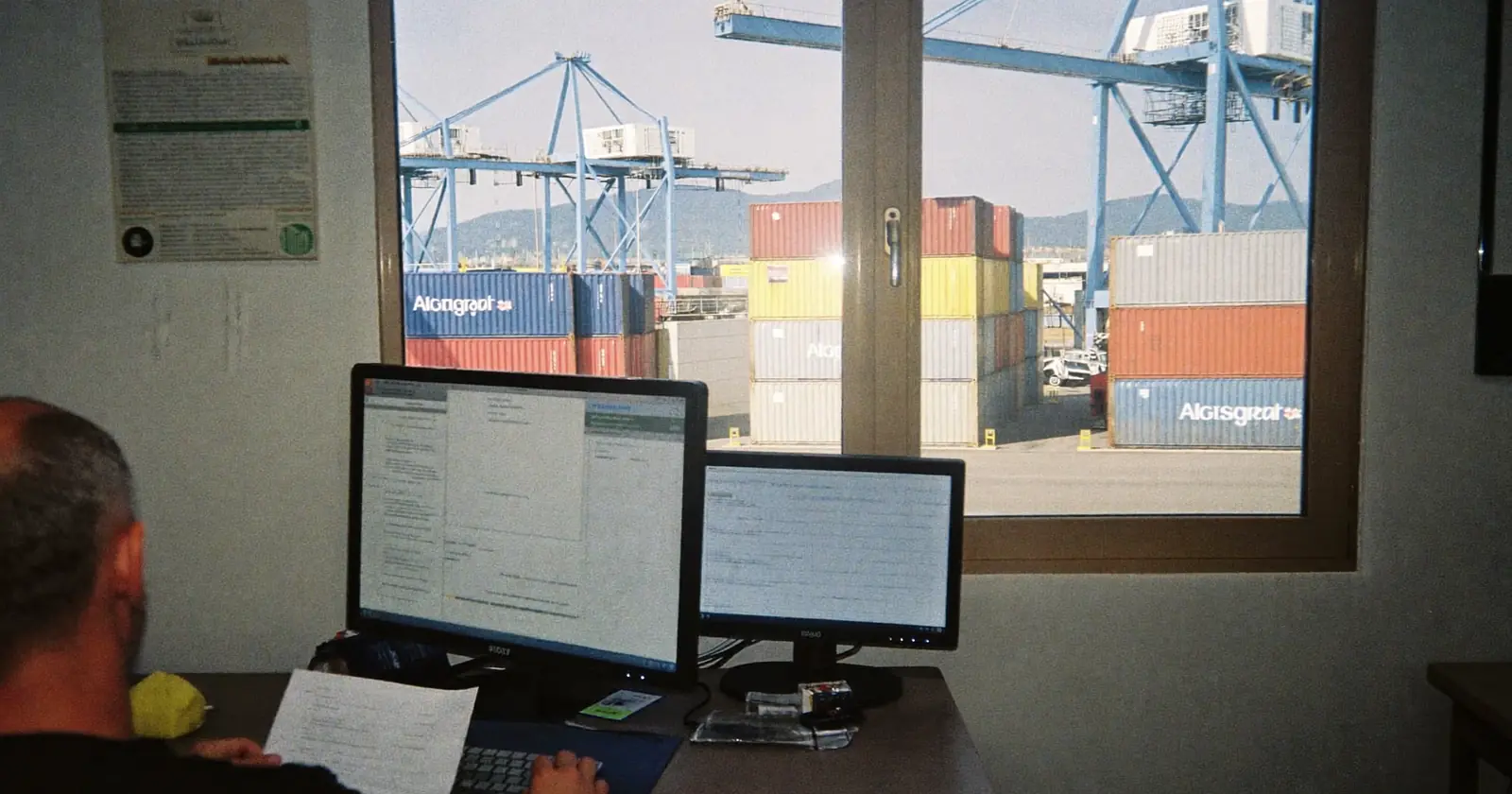
The ship berthed at ten past three in the morning at Isla Verde. At seven, the freight forwarder opens his laptop in an office on Avenida Virgen del Carmen with twenty-six messages and a lorry already queuing to enter the terminal. The Moroccan client wrote at four. The English correspondent, at half past six. Both ask the same thing: whether their cargo leaves today. And the answer is on a screen nobody has looked at, because at four in the morning there was nobody in that office.
That does not happen in an office in Seville or Madrid. It happens here, because the port never closes and your clients' time zones do not match your staff's working hours. This page is about how much of that mismatch artificial intelligence covers in a freight forwarder or customs agency in Algeciras, and how much it does not.
Why is this different in Algeciras?
Because the volume moving ten minutes from your desk is moved by no other city in the area: it is the second-largest container port in Spain, according to Puertos del Estado. But the figure that affects you is not tonnage, it is how many firms clear the same thing you do here.
That volume is not cleared by four multinationals but by a network of small offices: the Empresite directory lists 28 "customs freight forwarder" companies in Algeciras, and the Port Authority keeps its official list of freight forwarders and customs agents. Twenty-eight competitors in the same city, with the same short staff, offering the same clearance to the same importer.
When the shipping line, the terminal and the tariff are the same for all twenty-eight, what sets you apart is response time. The importer who asks at six in the morning and gets an answer at half past nine has not received bad service: they have received the same as any other name on that list would give. The one who answers in a minute is the one who is remembered.
With the Gibraltar border open, does my paperwork change?
Yes, and it is the reason this page is being written now and not three years ago. The land border between Gibraltar and La Línea opened on 15 July 2026, with the provisional application of the EU-UK agreement that reorganises mobility and controls. According to the analysis published in The Conversation, the result is the opposite of what was announced in 2016: what was promised to be closed is open.
For a freight forwarder in Algeciras that means import customs documentation enters a new scenario, with smaller and more frequent transactions, and with clients who have never cleared anything and ask on WhatsApp which document they need. That is the work that eats the morning of someone who knows tariffs: not the complex transaction, but the twentieth explanation of the day about which paper is needed. A conversational assistant covering that first layer (which document, in what format, in whose name) leaves you the judgement for what needs it. The other side of that conversation, the La Línea shop that imports across the border and has to put its invoices in order, is covered in open border in La Línea: invoices and paperwork.
Can a machine answer the three-in-the-morning phone?
Part of it, yes. In an office on the bay the phone does not ring during office hours: it rings when the ship berths, when the lorry reaches the gate and when the client on the other side of the Strait starts their working day. And the calls fall into two unequal piles.
The big pile is always the same: where is my cargo, has it left yet, what am I missing. A voice agent can take that call at any hour, in several languages, check the file status if that status lives in some system, and answer. If the call goes off script, it passes it to a person or leaves a message with the details already collected, not a "somebody called".
The small pile (the inspection, the incident, the angry client) is still yours. What changes is that at nine you do not start with twenty-six unopened messages, but with the three that needed your judgement.
A legal detail: the EU AI Act (Reglamento Europeo de IA) brings in transparency obligations for conversational systems from August 2026, so your assistant has to say it is automatic. It is not a commercial problem: someone calling at four in the morning prefers a machine that answers to a polite silence.
And the file? Can the paperwork itself be automated?
The paperwork itself (reading invoices, packing lists and bills of lading and transferring their data without typing) can be automated to a large extent, but it is a subject in its own right: we go through it document by document in AI for logistics and customs around the port of Algeciras, including the integration between programs so the data travels by itself. Here it is enough to know that tariff classification and responsibility before the Tax Agency remain with the professional, and that an assistant can only answer from what its systems allow it to read.
Is it worth it if there are three of us in the office?
Precisely because of that. According to the INE Central Business Directory, on 1 January 2025 54.4% of Spanish companies had no employees. When there is nobody to delegate to, the only way the four-in-the-morning phone gets answered by someone is for nobody to answer it.
And the field is empty: the INE survey on ICT use puts AI adoption at 13.4% of companies with fewer than ten employees in the first quarter of 2025. Among those 28 offices in Algeciras, answering in a minute is still an advantage and not a requirement to compete. In two years it will probably be the second.
Where would we start in an office in Algeciras?
Without changing your software and without touching everything at once:
- Measure a week of out-of-hours calls and messages. How many, in what language and how many asked about the status of a cargo. That number tells you whether your problem is the phone or the paperwork.
- Start with the big pile. File status and pending documentation: the repetitive and the multilingual.
- Integration, step by step. Connecting the file with what you invoice is a project of its own: how it is done is in the paperwork and integration guide.
- Build human validation into the design, not as a patch: anything with consequences at customs is confirmed by a person.
We are from the Campo de Gibraltar. If we need to come to your office to see what arrives by email on any given Tuesday and which screens you have open, we will: in a sector where the detail is in the specific document, that shows. You also have the page on AI automation in Algeciras and the AI use cases by sector in the Campo de Gibraltar.
Frequently asked questions
Can the voice agent take calls in the small hours, when there is nobody in the office? That is what it is for: it takes the call that comes in when the ship berths at three, finds out who is calling and what they need, and leaves it noted for first thing. Anything off script it flags for you to pick up.
Will the voice agent speak to my clients in Morocco and the United Kingdom? It can work in several languages and cover the first layer: file status, pending documentation, opening hours. Anything off script it passes to a person.
And if the system gets a figure wrong on a DUA (single administrative document)? That is why human validation is part of the design. The AI prepares and proposes; whoever signs the clearance reviews it. That step is not skipped.
There are four of us in the office. Isn't this for large operators? It makes more sense the shorter the staff: it is where there is nobody to pass the four-in-the-morning call to. Size is not needed, a repetitive flow is.
Tell us your case and we will say whether we can do it, how we would approach it and what it would cost. If it is not for us, we will tell you that too. Write to us from contact.

Xora IntelligenceAI consultancy and custom software in Los Barrios (Cádiz). We write about what we build for businesses in the province. If you have a question about your case, write to us.