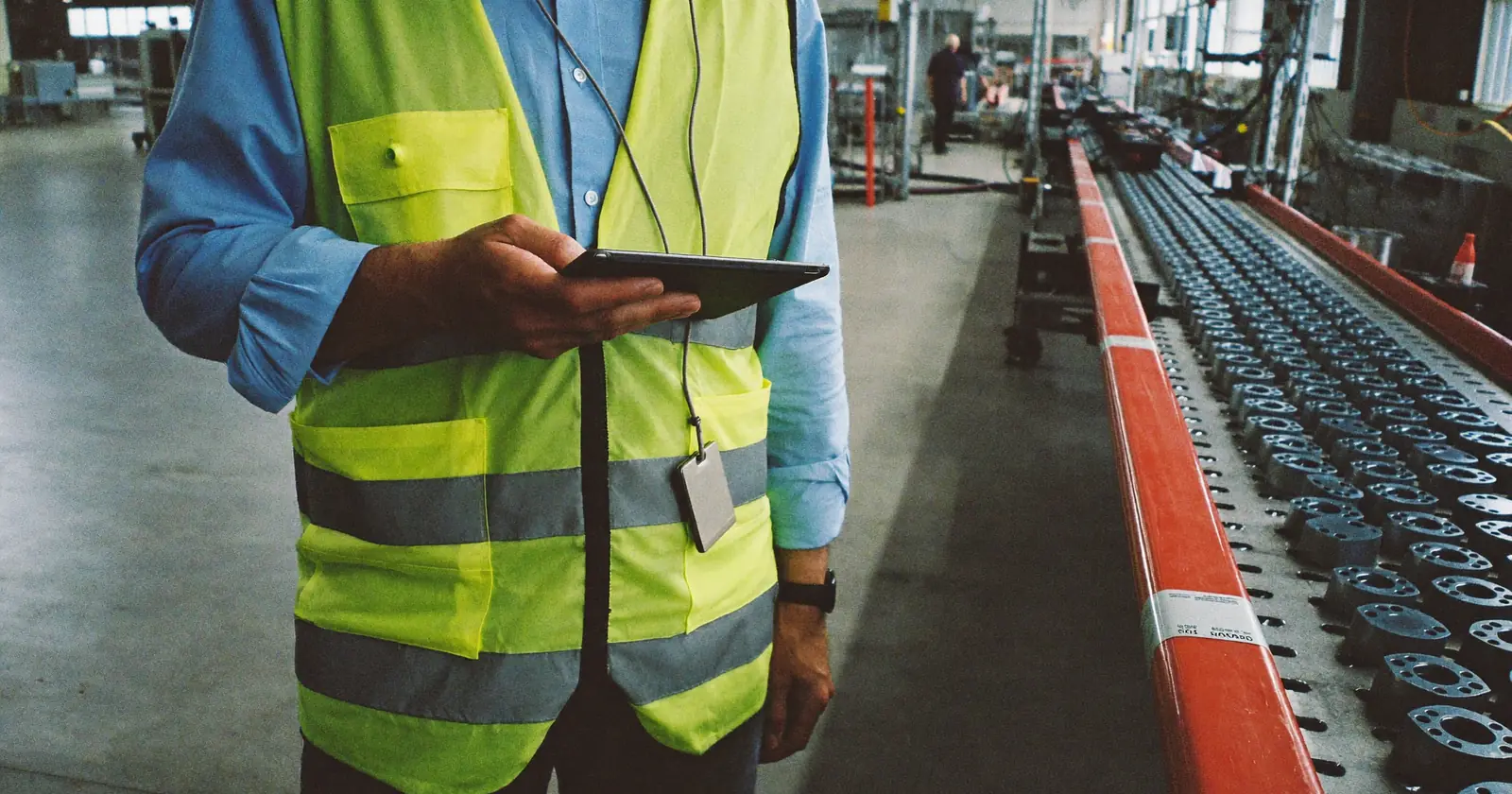
Eight in the morning in a unit in Guadarranque. The foreman of a subcontracting firm comes back from the maintenance shutdown at the plant next door with a bundle of paper work orders, some with grease on the edge. He sits down and starts entering them into the computer one by one: hours, operators, materials used, order number. While he types, an email arrives with a supplier's delivery note as a PDF. He opens it in another window and types that into the purchasing program too. It is half past nine and he has not yet started the work the company really does.
That scene repeats every morning in the units of Guadarranque, La Pólvora and Palmones. Here the bottleneck is not answering calls: it is the paper that goes back and forth between the unit, the plant and the supplier. Work orders, delivery notes, purchase orders, invoices. Data that already exists written down in one place and that somebody types in by hand again somewhere else. In this article we explain how document automation and integrations take that shuttling off your hands, without changing how you work with the plant.
Why does paperwork weigh so heavily on supplier industry and not on a shop?
Because your business does not sell to the public: it serves another company. And between two companies everything is documented. A neighbourhood garage gets paid on the spot and that is that. You deliver a job, issue a delivery note, wait for the plant's sign-off, invoice and wait to be paid. Every step leaves a paper or a PDF that has to go into a system.
The Guadarranque industrial estate, in San Roque, is completely occupied, with more than twenty companies and more than 200 jobs created. Many are maintenance, assembly or logistics subcontractors working around the big names in the area, such as Acerinox or Cepsa/Moeve. That network runs on documentation passed between companies, and the small end suffers most: a company of five or six people has no administration department, it has one person who does everything and a foreman who types up work orders in the morning.
It is no coincidence that this kind of company lags behind in digitalisation. According to the INE's ETICCE survey, only 13.4% of companies with fewer than 10 employees have adopted artificial intelligence. It is not that the small subcontractor does not want to: it has nobody to put on setting it up. That is where Xora comes in.
What can really be automated in a unit on the industrial estate?
The key is to go after the data that gets typed twice, without digitalising the whole company in one go. These are the specific pieces that an industrial or logistics company in the area can take off its plate.
Work orders and delivery notes entered by hand
The operator fills in the work order at the plant, on paper or on a phone, and then someone types it up in the office. You can set up a system where that work order is captured once and goes straight into your management software, with the hours, the materials and the order already filled in. The same goes for the supplier's delivery note that arrives as a PDF: instead of typing it, a system reads the document, extracts the data and puts it where it needs to go. You review; you do not transcribe.
Emails with PDFs that somebody opens and copies
In supplier industry half the working day goes on email: the purchase order from the plant, the carrier's delivery note, the supplier's materials sheet. Almost everything arrives as a PDF attachment and ends up copied by hand into a program. A software agent can watch that inbox, recognise what type of document each one is and load it into the right system. We explain it on the page about invoice and document automation.
Systems that do not talk to each other
This is the underlying problem. You have one program for work orders, another for purchasing, the spreadsheet and the email. None of them talks to the others, so the person is the glue: copy from one, paste into another. An integration connects those pieces so the data travels by itself. It is what Xora does with systems integrations: we do not change your tools, we make them stop being isolated.
What about B2B invoicing and slow payments?
This is a pain specific to your sector. In supplier industry you invoice another company and get paid on long terms. According to the CEPYME Late Payment Observatory, the average payment period was 80.5 days on average in 2025, when the legal maximum is 60 days under Law 3/2004. You get paid later than the law says, and every invoice that goes out late or with a mistake gets paid later still.
Automation will not make people pay your invoices sooner, let's be honest. But it does shorten what depends on you: getting the invoice out quickly, correctly and with the signed-off delivery note attached. The sooner and the better it goes out, the sooner the payment clock starts running.
And there is one more reason to get this in order now. Royal Decree 238/2026 makes the electronic invoice mandatory between businesses and professionals. A company that already has invoicing connected to its delivery notes and work orders will reach that change without surprises. One that is still typing up PDFs will not.
Is this for my company or for the big ones in the area?
It is precisely for the medium-sized and the small. Acerinox or a large logistics firm already has its systems department and its administration. The subcontractor in Palmones or La Pólvora that works for them does not: there, the foreman types up the work orders and the manager chases the invoices. That is why every morning lost to transcribing weighs more on the small company than on the big one.
And here is our edge. Xora is from the area. If we need to come to your unit to see how the work orders come in, how the delivery notes reach you and which program you use, we will. We do not set you up with a closed national product that would do for a factory in Valladolid as much as for one in Los Barrios: we build software to fit how you work with your plant. If your company is in San Roque, we explain it applied to your case in AI automation in San Roque. If you are in Los Barrios, the same in AI automation in Los Barrios. It is one continuous industrial corridor, and we work both ends.
Frequently asked questions
I don't want to change the management program I already use. Does this force me to? No. The normal approach is to start from what you already have and connect it, not replace it. An integration exists precisely so that your usual programs stop being isolated. If at some point it makes sense to tidy up a process, we look at it with you as we go.
Can a system really read a PDF delivery note without making mistakes? It reads and extracts the data, and leaves it ready for you to validate; it does not take it as correct blindly. Especially at the start, everything is checked. You go from typing every line to glancing over it and confirming: much less time and far fewer typing errors.
There are few of us in the company and nobody has time to set anything up. How does it start? With a single pain, the biggest one. Almost always it is "my morning goes on entering work orders" or "the PDF delivery notes". We build that piece, measure whether it pays off and only then add the next. There is no need to stop the unit.
And with mandatory electronic invoicing, do I have to do anything now? Royal Decree 238/2026 sets that obligation between businesses. Having invoicing connected to your delivery notes and work orders lets you reach that change without trouble. Tell us how you invoice today and we will tell you what would be needed.
Tell us how work orders come in at your unit, how the delivery notes reach you and which programs you work with. We will say whether we can do it, how we would approach it and what it would cost. If it is not right for your case, we will tell you that too. And if we need to come and see you on the industrial estate, we will. You can reach us from the contact page, and what each sector in the area can automate is gathered in the AI use cases by sector in the Campo de Gibraltar.

Xora IntelligenceAI consultancy and custom software in Los Barrios (Cádiz). We write about what we build for businesses in the province. If you have a question about your case, write to us.