
Web development
We design and code the whole website, not a retouched template. Corporate sites, catalogues, portals with a private area or online shops, with the AI layer built into the product rather than stuck on top.
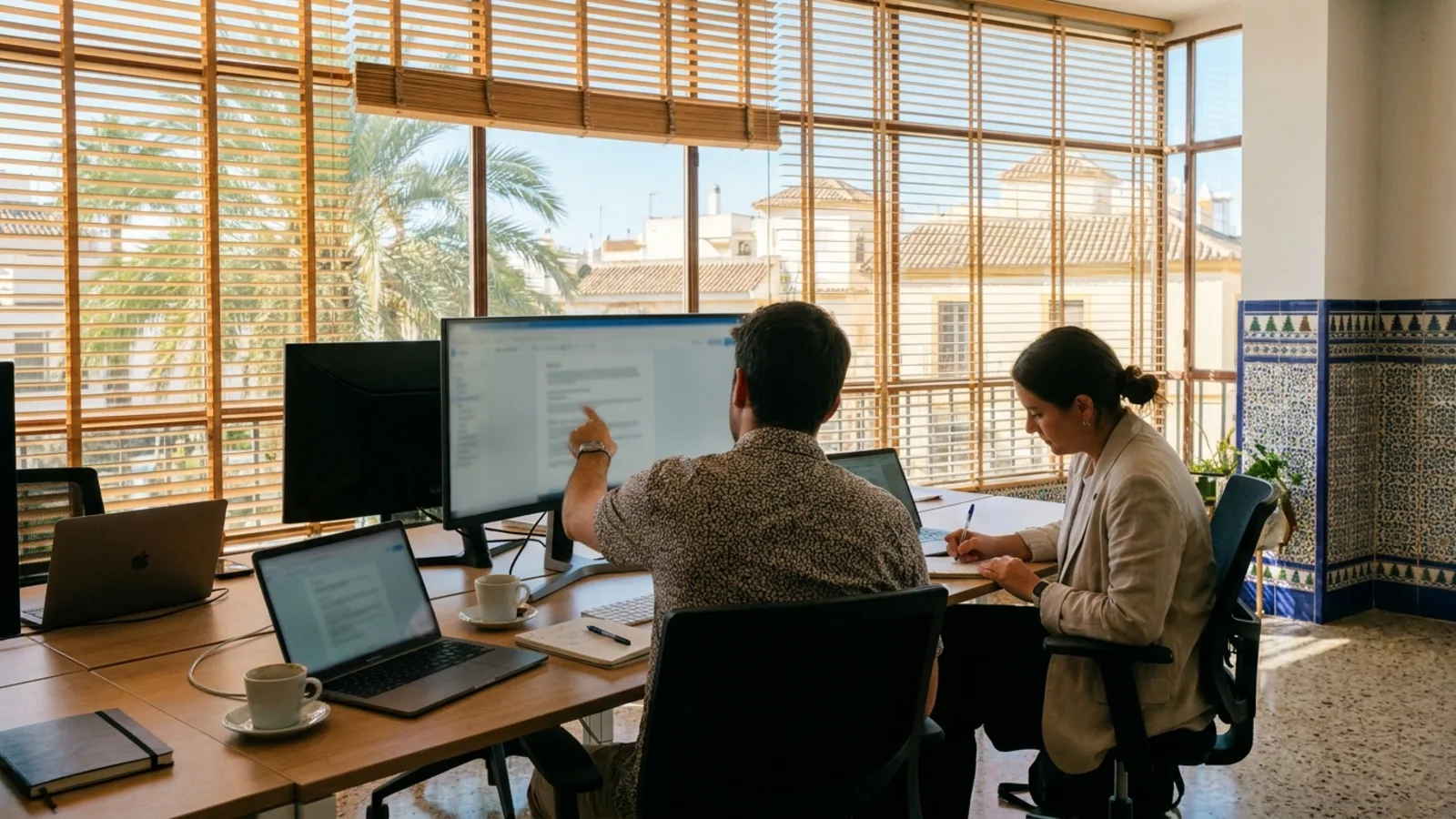
Your website was made by someone years ago, or you put it together yourself one weekend with a template. It shows who you are, more or less, and that's where it stops: it doesn't know your catalogue, it doesn't check your diary, and whatever comes in through the form ends up in an email someone forwards by hand. A custom website starts from the other end: from how you work and what you want to happen when someone uses it.
How can you tell a website isn't a template?
A template is a design made for nobody in particular, which is why it suits so many businesses: it doesn't know any of them. The problem shows up when you ask for something it doesn't do out of the box. That the customer requests a quote and it comes out with their details already filled in. That the alert goes to the warehouse and not to an inbox. Then the patching starts: one plugin, another on top, and a website loading things you don't use. Custom doesn't mean prettier: it means the structure comes from your business, and the odd parts of your business stop being a technical problem.
What kind of website do you really need?
Corporate: it tells people who you are, what you do and why they should call you. Being small doesn't make it the easiest: you have to decide what to say and what to leave out. Catalogue: product pages, filters and photos, but payment still happens elsewhere. Portal with a private area: each customer logs in and sees their own things (their files, their orders, their documents) and stops calling you to ask how it's going. Online shop: people also pay, and that brings stock, shipping, returns and invoices with it; if you sell to businesses in Spain, also factor in mandatory e-invoicing, already published in the Spanish Official State Gazette (BOE). You can start with one and grow into another. And if what you need fits on one page with your phone number and what you do, we'll tell you.
Source: BOE (Spanish Official State Gazette), royal decree on business-to-business e-invoicing
The AI goes inside the product, not stuck on top
Stuck on top is the chat bubble in the corner that only knows what it has read on the website itself. Inside is something else: the search understands the customer even when they don't use your words, and whatever comes in through the form reaches your system already sorted, not an inbox. That's decided at the design stage, because it changes how the data is stored. The form on this website writes straight into our CRM. If you also want an assistant that checks the diary and books appointments, that's our chatbots service. And when the website talks to a person, the EU AI Act requires it to identify itself as an automated system. We build it that way as standard.
Source: European Commission, regulatory framework for artificial intelligence
Who owns the website the day you leave?
It's the question to ask before signing, and the most expensive one. A website has five things that can be in your name or someone else's: the domain, the hosting, the code, the content and the access. If the domain was registered by whoever built the site, the day you part ways you'll be arguing over your web address, not the design. We set it up the other way from the start. The domain, in your name. The hosting, yours and with your passwords. The code goes with you. The text and photos, yours, with their licences documented. And if someone else takes over tomorrow, they can pick up where we left off. Ask for it in writing, from us and from anyone else who sends you a proposal.
A website that's slow on a phone gets seen by nobody
People visit from their phones, in a hurry and sometimes with poor signal. If it's slow, nobody waits: they go back and open the next one. What slows it down is usually the same: photos uploaded straight from the camera and third-party scripts that bring their own party. That's fixed with work, not by buying a plugin. It goes hand in hand with accessibility, the other half of the craft: contrast you can read in the sun, everything usable from the keyboard, labelled forms and alt text that describes the photo rather than repeating the headline. On this page, if nobody has written that text, the template doesn't show the photo. Open the code and check.
A website gets delivered, but it's never finished
Launch day isn't the end. Prices change, a new service comes in, a security flaw appears and something needs updating. The important question isn't who builds it: it's who maintains it and who'll be touching it next Tuesday. According to Spain's National Statistics Institute (INE), 54.4% of Spanish companies have no employees at all: often, whoever changes a price on the website is also serving at the counter. If moving a comma means opening a ticket, it never gets moved. That's why the editor has to be usable by someone who doesn't code. Tell us about your case and we'll tell you whether we can do it, how we'd approach it and what it would cost. If it isn't for us, we'll tell you that too.
Source: INE (Spanish National Statistics Institute), Central Business Directory as at 1 January 2025
Frequently asked questions
- Can I update the website myself?
- Yes, and it's designed for that. Text, prices, photos and new posts are changed from an editor, without touching code, and we show you how with your own website in front of you, not with a manual. Whatever shouldn't be touched by just anyone stays protected: nobody uses a panel where everything can break.
- I already have a website. Do I rebuild it or fix it?
- It depends, and rebuilding isn't always worth it. If yours loads quickly, looks right on a phone and brings you work, the problem isn't there. If every change has to be requested from someone else, if it looks broken on a phone or if nobody knows where the domain is, then there's a project. We look at it before proposing anything.
- Will it rank on Google?
- It will be ready to, which isn't the same thing. It's built to be indexed: fast, easy to understand and with structured data. That foundation is included; working on rankings afterwards is a separate service, our SEO one. Getting to the top depends on content, time and what others do; anyone who promises you a position is selling you something they don't control. That's the foundation.
- How much does a website cost?
- It depends on the type, on how many page types need designing, on whether it has to connect to your systems and on who writes the text and takes the photos. A shop with a payment gateway is nothing like a corporate site. We'll tell you on the call, once we know what needs building.
How we work
01
Understand
We sit down with you and look at how you really work. We come away knowing what makes sense to build and, above all, what doesn't.
02
Build
We build it on the tools you already use and show it to you working, not in a slide deck.
03
Stay with you
We measure, we adjust and you can always reach us. Software isn't something you install and forget.
Other services
Chatbots and conversational AI
Assistants that talk to your customers on WhatsApp and actually sort things out.
See detailsCustom applications
Software that doesn't exist on the market because your process is yours.
See detailsDocument automation
Invoices, delivery notes and contracts that read and file themselves.
See details