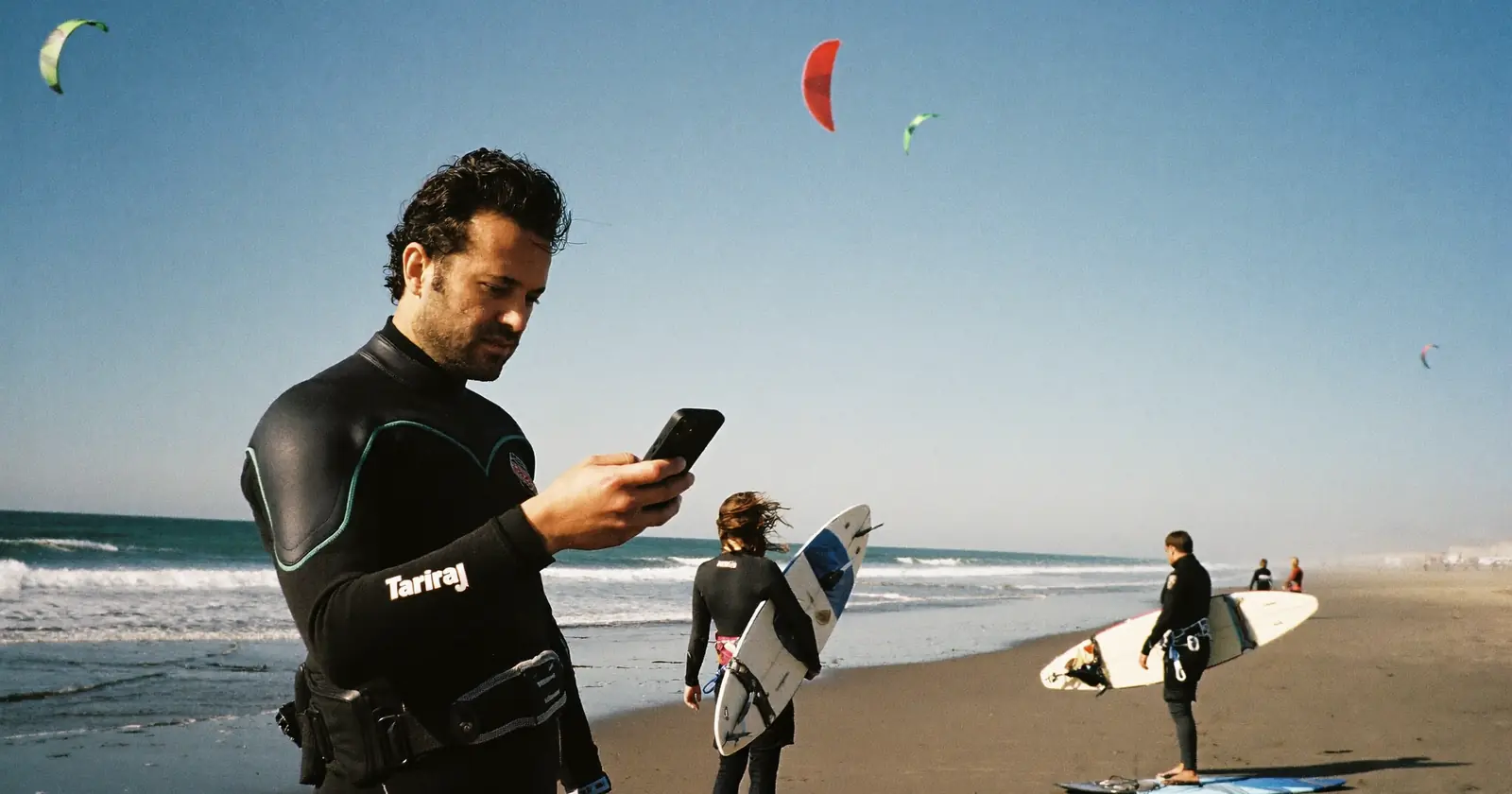
A strong levante wind on a Saturday in August at Los Lances. The instructor is in the water with four beginners clinging to the bar, never taking his eyes off any of them. On the shore, the school's phone has been buzzing inside a rucksack for twenty minutes: two Germans asking if there is a lesson tomorrow, a couple from Madrid who want to know if their level is good enough, someone asking if there is a place left in the afternoon group. Nobody can pick it up. By the time the instructor steps onto the sand, there are nine messages and three have already gone to the school next door.
In Tarifa, business does not run at a steady pace. It runs in bursts of wind and calendar. And that is exactly the problem they do not have in Algeciras or San Roque.
Why is Tarifa not like the rest of the area?
Because here seasonality is not a smooth curve, it is a cliff. A kite school goes from two instructors in March to seven in August, and from a handful of students to filling every session of the day. According to figures published by the schools in the sector themselves, that jump goes from about 6 students a day in the slow season to 30 at peak. The same premises, the same person in charge, and suddenly five times as many people writing at once.
The same happens to the accommodation that hangs out the no-vacancy sign for three months and renegotiates the electricity bill the other nine. And to the beach bar, and to the activities company that runs four outings in winter and cannot cope in summer. Tarifa's seasonal business base is real and serious: just look at the list of kitesurf schools approved by the Andalusian Sailing Federation (Surf Center Tarifa, Tarifa Kite Passion, Kite and Roll, Chicken Loop, Wayuu Kite School and many more) to see the density of business concentrated here along a few kilometres of coast.
And every summer it weighs more. The Cádiz Provincial Council's Tourism Board, with INE data, closed 2025 with more than 11.1 million overnight stays, a record for the province. More people, more messages, the same number of hands to answer them.
What really overwhelms you in August?
It is not teaching. It is not making the beds. It is everything that goes on around you while you do your job.
In a seasonal business most of the questions repeat and arrive just when you cannot deal with them:
- Is there wind tomorrow? What is the forecast for the weekend? Can we sail in this levante or is Thursday better?
- Are there places left? For tomorrow morning, for the five o'clock group, for the whole of next week.
- Is this for me? I have never kited, do I start from zero? Is it suitable for my fourteen-year-old? How long does a beginners' course last?
- Bookings and changes: confirming, moving a lesson because of the weather report, flagging a cancellation, asking for the meeting point.
Each of those messages is small. Together, in high season, they are a whole person dedicated only to the phone. A person you do not have. And whoever does not reply in Tarifa in August loses the booking within minutes, because the customer has ten more schools one message away.
How does an AI agent absorb that peak?
A conversational agent answers on WhatsApp, on Instagram or from your website with what you have loaded into it: your wind report, your levels, your sessions. It is not an answering machine with a menu. To whoever asks whether tomorrow is sailable in the levante, it replies the way you would from the water.
Applied to a seasonal business in Tarifa, it does specific things:
- It answers the usual questions at any hour: levels, what to bring, where the meeting point is, whether you need to be able to swim, what happens if there is no wind that day. Without you touching your phone.
- It manages availability and bookings: it shows which sessions are left, takes the customer's details, confirms and sends a reminder. A chatbot connected to your diary works the same at nine at night as in the middle of a lesson.
- It reschedules when the forecast changes: if the levante forces you to move the session, it can notify the people booked in and offer the alternative slot, instead of you doing it message by message.
- It filters and passes on what matters: it closes the routine ones itself; whatever needs your judgement (a big group, an odd enquiry, someone undecided) it leaves flagged for you to finish off.
And here is what really fits with seasonality: in August it absorbs the peak of messages without getting tired or charging overtime, and in February it is still there, answering the day's four enquiries without the cost of having someone on the payroll. It goes up and down with your season, which is exactly what your staff cannot do.
My customers come from all over the world. Does it work for that?
It does, and in Tarifa this is not decoration. A good share of the people who write to you are German, French, English, Dutch. The agent replies in the language it is spoken to in, so you do not have to get by in five languages while you are in the water.
And you already know how they write to you: by messaging. According to Eurostat data, in 2025 94.7% of the Spanish population used instant messaging, against 82.3% on average in the EU. The tourist who comes to Tarifa does not phone: they send you a WhatsApp or a DM. Being well looked after there is being where the customer is.
If you also have accommodation, the same logic repeats for check-in, arrival instructions and the "can I come in early?". We cover that separately in the guide to WhatsApp chatbots for hotels and accommodation.
And if I'd rather it spoke than wrote?
For that there is the other route: a voice agent that picks up the phone when you cannot. In a seasonal business, answering the call that comes in while your hands are busy is the difference between that booking and the school next door. The agent answers, sorts out the basics and passes on whatever really needs you to speak.
It is not magic and we do not sell it as such. It is a tool that does one very specific thing well: that no message and no call goes unanswered in the week that matters most to you.
Frequently asked questions
Do I have to change the way I work? No. The agent connects to your WhatsApp, your Instagram or your website and to the diary you already use. You carry on teaching or running the accommodation; what changes is that you stop losing messages.
And in the low season, when there are hardly any enquiries, isn't it money down the drain? That is precisely the point. You do not pay for extra instructors in winter; it makes no sense to pay for handling a volume that does not exist either. We size it to follow your season, not to weigh on you when there is no work.
Will the AI make up answers about the wind or the levels? It answers with what you give it: your forecast, your levels, your rules, your meeting point. What it does not know, it does not invent: it refers it to you. And where the law requires saying that you are talking to an automated system, it says so.
Are you local, or do I have to ring Madrid? We are from the Campo de Gibraltar. If we need to come up to Tarifa to see you and understand how your school or your accommodation works in August, we will. A national supplier does not come down to Los Lances to see what overwhelms you.
Tell us your case from the contact page and we will say whether we can do it, how we would approach it and what it would cost. If it is not for us, we will tell you that too. And if you would like to see first how AI fits other businesses in the area, there is the guide for businesses in the Campo de Gibraltar and the page on AI automation in Tarifa.

Xora IntelligenceAI consultancy and custom software in Los Barrios (Cádiz). We write about what we build for businesses in the province. If you have a question about your case, write to us.